


The Mathematical Concept of Ratios in Saree Styling: The Science Behind Pleats, Length, and Fall
At first glance, a saree appears to be a beautiful expression of culture, craftsmanship, and personal style. However, beneath its elegance lies an intricate relationship with mathematics. Every well-draped saree reflects a careful balance of proportions, measurements, and ratios that determine how gracefully it falls and how aesthetically pleasing it appears.
Whether consciously or instinctively, every saree wearer uses mathematical principles while adjusting pleats, managing pallu length, or setting the hemline. The secret of a perfectly draped saree is often hidden in the science of ratios.
Understanding Ratios in Design
A ratio is a mathematical relationship between two quantities.
Ratios help maintain balance and proportion in:
-
Architecture
-
Art
-
Fashion
-
Interior design
-
Nature
In saree styling, ratios determine how fabric is distributed across different sections of the drape.
The objective is simple:
Create visual harmony while ensuring comfort and functionality.
The Saree as a System of Proportions
A standard saree measures approximately 5.5 to 6 meters.
This length is generally divided into three functional sections:
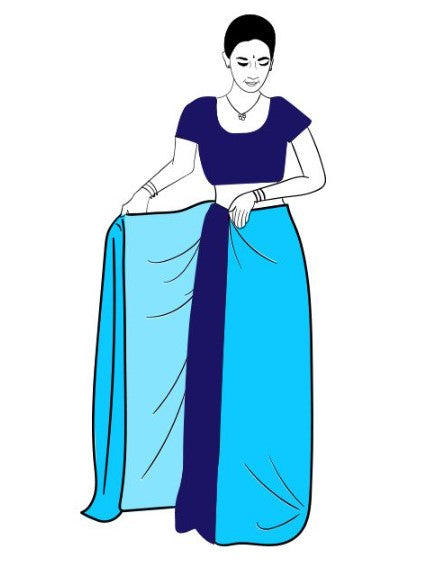
1. Waist Wrap
Fabric used to secure the saree around the waist.
2. Pleat Section
Fabric allocated for front pleats.
3. Pallu Section
Fabric reserved for shoulder draping and visual impact.
The beauty of the saree depends on maintaining proper proportions among these three zones.
Too much fabric in one section often affects the balance of the entire drape.

The Ratio of Pleat Width to Pleat Count
Pleats are one of the most mathematical elements of saree styling.
A fixed amount of fabric must be divided into equal sections.
For example:
-
More pleats = narrower pleat width
-
Fewer pleats = wider pleat width
This creates a balance between:
-
Volume
-
Structure
-
Movement
Well-proportioned pleats create symmetry and rhythm, while uneven pleats disrupt the visual flow.
The eye naturally appreciates repetition and consistency, making equal pleat ratios essential to elegance
The Relationship Between Pleats and Body Proportion
Pleat size often varies according to body frame.
Smaller Pleats
-
Create a refined appearance
-
Offer greater flexibility
-
Produce softer movement
Wider Pleats
-
Add visual volume
-
Create a stronger silhouette
-
Enhance structural presence
Stylists often adjust pleat ratios to complement the wearer's proportions, demonstrating how mathematics and aesthetics work together.

The Pallu-to-Body Ratio
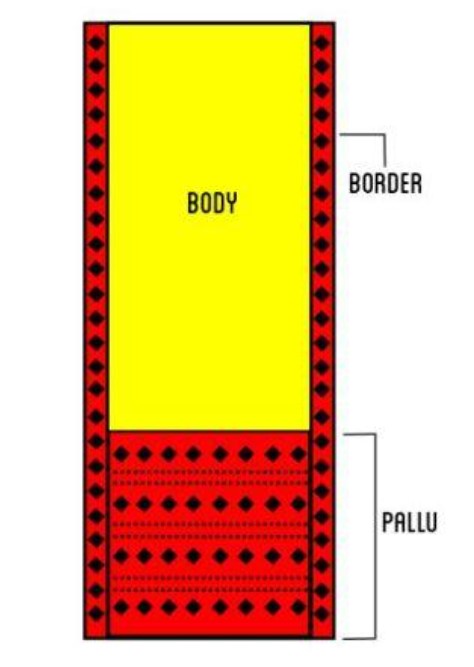
One of the most important ratios in saree styling is the relationship between the pallu and the body drape.
The pallu acts as the visual focal point.
If the pallu is too short:
-
The saree may appear incomplete.
-
Visual balance shifts downward.
If the pallu is too long:
-
The upper portion may dominate the entire look.
-
Proportions may feel exaggerated.
A balanced pallu creates harmony between:
-
Upper body
-
Lower body
-
Overall silhouette
This ratio contributes significantly to elegance and grace

Fall Length and Ground Clearance
The lower edge of a saree, commonly known as the fall, also depends on proportional measurement.
An ideal fall length should:
-
Touch close to the feet
-
Avoid dragging excessively
-
Maintain smooth movement
This creates a ratio between:
-
Wearer height
-
Saree length
-
Foot clearance
Even a small deviation can affect both appearance and comfort.
A properly balanced fall enhances posture and creates a clean vertical line.

Vertical and Horizontal Proportions
The saree simultaneously manages two dimensions:
Vertical Ratio
Determines perceived height.
Influenced by:
-
Pallu length
-
Border width
-
Fall positioning

Horizontal Ratio
Determines perceived width.
Influenced by:
-
Pleat volume
-
Waist wrapping
-
Drape spread
The interaction of these ratios shapes the overall visual effect.

Border Width Ratios
Traditional sarees often feature decorative borders.
The width of these borders affects perception.
Narrow Borders
-
Create a lighter appearance
-
Enhance height perception
Wide Borders
-
Add visual weight
-
Emphasize richness and grandeur
Designers carefully select border proportions to complement the saree's overall composition.
The Golden Principle of Visual Balance
Many successful saree styles naturally follow principles similar to those found in classical design.
The eye tends to prefer:
-
Balanced divisions
-
Consistent spacing
-
Harmonious proportions

This is why experienced drapers instinctively adjust:
-
Pleat spacing
-
Pallu length
-
Waist positioning
until the saree "looks right."
What appears intuitive is often mathematical balance at work.
Ratios and Movement
Ratios influence not only appearance but also motion.
A well-balanced saree allows:
-
Smooth walking
-
Comfortable sitting
-
Graceful turning
-
Natural flow
Improper proportions can lead to:
-
Bulky pleats
-
Restricted movement
-
Uneven draping
-
Visual imbalance
Thus, mathematical ratios contribute directly to functionality.
Saree Styling as Applied Mathematics
Every saree drape involves continuous decision-making:
-
How much fabric to allocate for pleats?
-
How long should the pallu be?
-
How wide should each fold become?
-
Where should the fall end?
These questions are fundamentally mathematical.
Without calculations, measurements, and proportional thinking, achieving a balanced drape becomes difficult.
-
Influence of Gravity and Force Distribution in Saree Draping: The Physics Behind Elegance
The beauty of a saree is often described in terms of color, fabric, weaving, or craftsmanship. Yet one of the most important contributors to its elegance remains invisible—the force of gravity.
Every fold, pleat, curve, and flowing pallu owes its existence to gravity. The graceful fall of a saree is not accidental; it is the result of a delicate interaction between fabric weight, body structure, force distribution, and movement.
In many ways, a saree is a living demonstration of physics in action.
Gravity: The Invisible Designer
Gravity is the force that pulls all objects toward the Earth.
In a saree, gravity continuously acts on:
-
Pleats
-
Pallu
-
Borders
-
Embroidery
-
Fabric layers
Without gravity, a saree would not drape naturally around the body. Instead, it would remain suspended and shapeless.
The elegant vertical flow associated with sarees is largely a consequence of gravitational force.
The weight acting on the fabric can be represented by:
This simple principle governs how every section of the saree behaves.
Why Fabric Falls Downward
When a saree is draped, gravity pulls every portion of the fabric downward.
However, the body provides support at key points:
-
Waist
-
Shoulder
-
Hip region
-
Tucked sections
As a result, the fabric settles into natural curves and folds.
The final shape emerges from a balance between:
-
Downward gravitational force
-
Supporting body structure
-
Fabric flexibility
This balance creates the signature drape of a saree.
Force Distribution Across the Saree
A saree may appear lightweight, but several kilograms of fabric, embellishments, and embroidery can generate significant force.
Interestingly, this force is not concentrated in one place.
Instead, it is distributed across multiple support points.

The Waist
The waist acts as the primary load-bearing region.
It supports:
-
Wrapped fabric
-
Pleated sections
-
Part of the pallu weight
This is why proper tucking is crucial.
The Shoulder
The shoulder supports:
-
The pallu
-
Decorative borders
-
Embroidery weight
A heavier pallu creates greater downward pull on the shoulder.
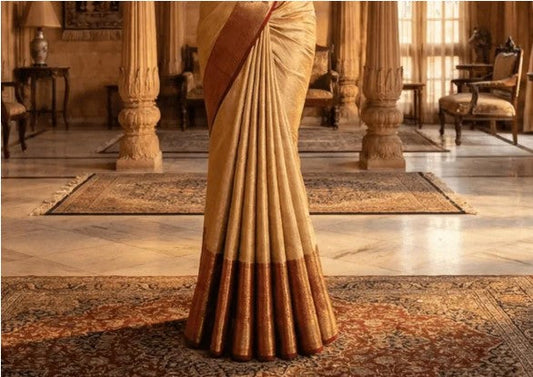
The Pleats
Pleats distribute fabric mass vertically.
Instead of creating a bulky structure, they organize weight into manageable sections.
This improves both appearance and mobility.

Why Some Fabrics Drape Better
Not all fabrics respond to gravity in the same way.
Georgette and Chiffon
-
Lightweight
-
High flexibility
-
Soft gravitational fall
-
Fluid movement
Silk
-
Moderate weight
-
Structured drape
-
Strong shape retention
Cotton
-
Greater stiffness
-
More resistance to folding
-
Crisp appearance
The interaction between fabric weight and gravity determines the final silhouette.
The Science Behind Pleat Formation
Pleats exist because gravity continuously pulls folded fabric downward.
When pleats are tucked:
-
Gravity keeps them aligned vertically.
-
Fabric weight stabilizes the folds.
-
Repeated folds create organized force channels.
This explains why well-made pleats often appear neat and symmetrical.
Gravity naturally assists in maintaining their shape.
The Pallu as a Hanging Structure
The pallu behaves like a suspended textile system.
Once placed over the shoulder:
-
One end remains anchored.
-
The remaining fabric hangs freely.
Gravity stretches the pallu downward, creating:
-
Smooth lines
-
Elegant curves
-
Visual flow
The heavier the border or embroidery, the more pronounced the fall becomes.
This is why designer pallus often create a dramatic visual effect.
Balance Between Weight and Comfort

An ideal saree balances beauty with practicality.
Excessive weight can cause:
-
Shoulder strain
-
Waist pressure
-
Restricted movement
Insufficient weight may cause:
-
Unstable pleats
-
Excessive shifting
-
Poor drape definition
Designers therefore carefully consider:
-
Fabric GSM (grams per square meter)
-
Border thickness
-
Embellishment density
-
Weaving techniques
to achieve optimal force distribution.
Gravity During Movement
A saree is never completely static.
As the wearer walks:
-
Fabric swings
-
Pleats shift
-
Pallu flows
-
Folds adjust
Gravity continuously works to restore balance.
This dynamic interaction creates the graceful movement for which sarees are famous.
Every step becomes a blend of physics and fashion.
Traditional Draping: A Masterclass in Engineering
Centuries before modern textile science, traditional draping methods had already mastered force management.
The saree distributes weight through:
-
Strategic wrapping
-
Waist anchoring
-
Pleat organization
-
Shoulder balancing
These techniques allow a large piece of fabric to remain secure without extensive stitching.
It is an elegant engineering solution developed through generations of practical knowledge.
The Relationship Between Gravity and Elegance
The graceful appearance of a saree is not created solely by design.
It emerges from the partnership between:
-
Fabric
-
Body structure
-
Motion
-
Gravity
Every flowing pallu, every cascading pleat, and every smooth fold represents gravity working harmoniously with textile design.
What we perceive as elegance is often the visible result of invisible physical forces.
The Connection Between Mathematics, Physics, and Aesthetics in the Saree: Where Science Meets Beauty
For centuries, the saree has been celebrated as one of the most elegant garments in the world. It is admired for its grace, versatility, and cultural significance. Yet behind its beauty lies something even more fascinating—a remarkable blend of mathematics, physics, and aesthetics.
At first glance, the saree appears to be a simple length of fabric. But when draped, it becomes a masterpiece of proportion, balance, movement, and design. Every fold, pleat, curve, and flowing pallu reflects principles that scientists, mathematicians, architects, and designers have studied for generations.
The saree is not merely fashion. It is science expressed through fabric and beauty.
Three Worlds, One Garment
A perfectly draped saree exists at the intersection of three disciplines:
Mathematics
Determines proportion, symmetry, repetition, and geometry.
Physics
Controls movement, gravity, force distribution, and stability.
Aesthetics
Creates elegance, harmony, emotional appeal, and visual beauty.
Together, these elements transform a flat piece of cloth into a living work of art.
Mathematics: The Hidden Structure of Saree Design

Before a saree becomes beautiful, it must first become organized.
Mathematics provides this organization.
Geometry of the Saree
A saree begins as a rectangle.
This simple geometric form serves as the foundation for:
-
Waist wrapping
-
Pleat formation
-
Pallu arrangement
-
Border alignment
From a mathematical perspective, the saree is a study in transforming a two-dimensional surface into a three-dimensional structure.
Ratios and Proportions
A balanced saree relies heavily on proportional relationships.
Examples include:
-
Pleat width versus pleat count
-
Pallu length versus body drape
-
Border width versus fabric area
-
Fall length versus wearer height
When these ratios are balanced, the saree appears visually harmonious.
Symmetry and Repetition
Human beings naturally appreciate patterns.
Pleats create:
-
Repetition
-
Rhythm
-
Predictability
-
Order
These mathematical principles make a saree visually satisfying even before color or embellishment is considered.
Physics: The Force Behind the Flow

If mathematics creates structure, physics brings the saree to life.
The moment a saree is draped, physical forces begin to act upon it.
Gravity Creates the Drape
The graceful fall of a saree exists because gravity pulls fabric downward.
This invisible force shapes:
-
Pleats
-
Pallu flow
-
Fabric curves
-
Vertical alignment
Without gravity, the saree would lose its characteristic elegance.
Force Distribution
A saree remains secure because weight is distributed across:
-
Waist
-
Hip region
-
Shoulder
-
Tucked sections
This distribution prevents excessive strain and allows the garment to remain comfortable despite its length.
Movement and Motion
As the wearer walks:
-
Fabric responds to motion.
-
Pleats expand and contract.
-
The pallu sways.
-
Folds adjust continuously.
The saree becomes a dynamic system governed by the laws of motion.
Its beauty changes with every step.
Aesthetics: The Language of Beauty
While mathematics provides structure and physics provides movement, aesthetics provides meaning.
Aesthetics determines how the saree is perceived.
Visual Balance
The pallu acts as a visual counterweight to the lower drape.
This creates harmony between:
-
Upper body
-
Lower body
-
Overall silhouette
Balanced compositions naturally feel beautiful to the human eye.
Color and Contrast
Colors influence emotional response.
Different color combinations create:
-
Energy
-
Calmness
-
Sophistication
-
Celebration
Designers use color relationships to enhance the visual impact of the saree.
Flow and Grace
People often describe a saree as graceful.
Interestingly, grace is not a decorative element.
It emerges from the interaction of:
-
Fabric weight
-
Gravity
-
Movement
-
Body posture
In other words, aesthetics is often the visible outcome of mathematical and physical principles working together.
The Saree as a Living Design System
Unlike most garments, the saree does not have a fixed form.
It changes according to:
-
Body shape
-
Draping style
-
Fabric type
-
Movement
-
Occasion
This flexibility makes it one of the most sophisticated design systems ever created.
A single saree can become:
-
Traditional
-
Contemporary
-
Formal
-
Festive
-
Minimalist
-
Grand
All through changes in arrangement rather than construction.
Why the Saree Feels Timeless
-
Many fashion trends fade because they depend heavily on temporary aesthetics.
-
The saree survives because it is built upon universal principles.
-
Mathematics provides order.
-
Physics provides functionality.
-
Aesthetics provides emotional appeal.
-
These principles remain relevant regardless of era, culture, or fashion trend.
-
This is why a saree worn today can feel just as elegant as one worn centuries ago.

The Perfect Harmony
-
The true genius of the saree lies in its ability to unite disciplines that are often viewed separately.
-
A pleat is mathematics.
-
A flowing pallu is physics.
-
The resulting elegance is aesthetics.
-
Together they create something greater than the sum of their parts.
-
The saree becomes a perfect example of how science and art are not opposites but partners.
Tags:
Related articles

Jul 29 2026
A Saree as a Guru – Life Lesson
Jul 25 2026
Chapter 25 – The Science of Comfort l RESSA
Jul 25 2026
