


Waist Wrapping as Cylindrical Geometry: The Hidden Mathematics of Saree Draping
The saree is often admired for its beauty, elegance, and cultural significance. Yet beneath its artistic appeal lies a fascinating world of geometry and body science. One of the most fundamental aspects of saree draping is the way the fabric wraps around the waist. This seemingly simple action is actually an excellent example of cylindrical geometry in everyday life.
Understanding the Waist as a Cylinder
In geometry, a cylinder is a three-dimensional shape with a circular cross-section and a constant radius along its height. While the human body is not a perfect cylinder, the waist region closely resembles a cylindrical form for the purpose of garment draping.
When a saree is tucked and wrapped around the waist:
-
The waist acts as the central cylindrical structure.
-
The saree fabric becomes a flexible surface wrapping around that cylinder.
-
The circumference of the waist determines how much fabric is required for a secure drape.
-
The tension created during wrapping keeps the saree in position without the need for extensive stitching.
This interaction between body shape and fabric geometry forms the foundation of traditional saree draping.
The Mathematics of Circumference
Every wrap around the waist follows a simple geometric principle:
Circumference = 2πr
Where:
-
r is the radius of the waist.
-
The circumference represents the distance around the body.
The saree must cover this circumference comfortably while allowing additional fabric for:
-
Tucking
-
Movement
-
Pleat formation
-
Pallu arrangement
This is why a saree typically ranges from 5.5 to 9 meters in length, providing enough fabric for both structural and decorative functions.
How Fabric Creates Stability
A saree remains secure because the fabric creates friction against itself and against the body.
The first wrap establishes a stable cylindrical layer around the waist. Each subsequent layer increases:
-
Friction
-
Stability
-
Weight distribution
-
Structural support
The greater the contact area between the fabric and the waist, the more secure the drape becomes.

The Waist as a Load-Bearing Structure
An interesting aspect of saree design is that the waist acts as the primary support system for the entire garment.
The waistband region carries:
-
Pleats in the front
-
Decorative borders
-
Embellishments
-
The weight of the pallu
Instead of concentrating weight on the shoulders, the saree distributes much of its load around the cylindrical waist structure. This contributes to comfort during long periods of wear.
Circular Distribution of Fabric
Unlike stitched garments that depend on fixed seams, the saree distributes fabric continuously around the body.
Benefits include:
1. Uniform Pressure Distribution
The wrap spreads pressure evenly around the waist rather than concentrating it at specific points.
2. Flexibility
The drape adapts naturally to different body shapes and sizes.
3. Freedom of Movement
Walking, sitting, and bending are easier because the fabric adjusts dynamically around the cylindrical waist.
4. Adjustable Fit
The same saree can fit different body measurements through changes in wrapping tension.
Geometry of Tucking
The tuck is one of the most important engineering features of a saree.
When fabric is inserted into the waistband:
-
Compression forces hold it in place.
-
Friction prevents slipping.
-
The cylindrical shape provides continuous support around the body.
This creates a self-locking mechanism without requiring buttons, zippers, or hooks.

Cylindrical Geometry and Pleat Formation
Once the waist wrap is established, pleats are formed.
These pleats:
-
Originate from the cylindrical base.
-
Fold into repeated geometric segments.
-
Expand and contract during movement.
The waist wrap acts like an anchor point from which the entire front structure of the saree is organized.
Why the Design Has Survived for Centuries
The saree's longevity is not accidental. Its success comes from a combination of:
-
Mathematical efficiency
-
Geometric adaptability
-
Structural stability
-
Human comfort
The cylindrical waist wrap allows a simple rectangular fabric to transform into a secure, elegant, and highly functional garment.
-
Pallu as a Visual Proportion and Balance Element: The Design Science Behind Saree Elegance
When people think of a saree, their attention is often drawn to the pallu—the flowing end piece that drapes over the shoulder. Traditionally decorated with intricate motifs, rich weaves, embroidery, or striking colors, the pallu is much more than a decorative feature.
From a design perspective, the pallu serves as a powerful tool of visual proportion, balance, and composition. It transforms a simple length of fabric into a harmonious and aesthetically pleasing garment. In many ways, the pallu functions like the focal point of a painting, guiding the viewer's eye and creating visual equilibrium.
What Is Visual Balance?
Visual balance refers to the distribution of visual weight within a design.
Just as physical objects have weight, design elements possess visual weight based on:
-
Color intensity
-
Pattern density
-
Fabric texture
-
Embroidery
-
Shine and contrast
-
Size and placement
A well-balanced design feels harmonious and comfortable to the eye. An unbalanced design may appear awkward or incomplete.
The saree achieves this balance primarily through the pallu.
The Saree as a Moving Composition
Unlike a painting or photograph, a saree is a dynamic composition that changes with movement.
The saree consists of three major visual zones:
1. Waist and Pleat Region
The structural center of the garment.
2. Body Drape
The largest visual surface area.
3. Pallu
The dominant visual accent and focal point.
Among these, the pallu often carries the highest visual weight because of its elaborate design and strategic placement near the upper body.
The Pallu Creates Visual Direction
Human eyes naturally follow lines, contrasts, and movement.
The pallu guides attention through:
-
Vertical flow
-
Diagonal draping
-
Contrasting colors
-
Decorative borders
-
Embroidered highlights
This creates a visual journey from the shoulder to the lower body, making the overall appearance more graceful and connected.
Balancing the Upper and Lower Body
One of the most important functions of the pallu is balancing body proportions.
Without a pallu, the visual weight of the saree remains concentrated around the waist and lower body.
The pallu redistributes attention upward by:
-
Drawing focus toward the face
-
Highlighting the shoulders
-
Creating height perception
-
Enhancing posture
This helps create a balanced silhouette.

The Rule of Visual Weight
Designers often treat the pallu as the "counterweight" of the saree.
For example:
-
Heavy borders often pair with lighter body designs.
-
Rich pallus are balanced with simpler pleats.
-
Minimalist sarees may use statement pallus for emphasis.
This prevents visual overcrowding and creates harmony.

The Pallu as a Focal Point
Every successful design needs a focal point.
In architecture, it may be a grand entrance.
In photography, it may be the subject.
In a saree, it is often the pallu.
A focal point:
-
Captures initial attention
-
Creates identity
-
Adds memorability
-
Defines style
This is why traditional sarees frequently reserve their most intricate artistry for the pallu section.

Proportion and Scale in Saree Design
The size of the pallu significantly influences visual proportion.
Short Pallu
-
Creates a neat appearance
-
Feels structured
-
Suitable for formal environments
Medium-Length Pallu
-
Offers balanced elegance
-
Maintains symmetry
Long Flowing Pallu
-
Creates dramatic movement
-
Enhances grandeur
-
Adds visual height
Designers carefully adjust pallu dimensions to achieve the desired aesthetic effect.
Symmetry and Asymmetry
Interestingly, the pallu introduces controlled asymmetry into the saree.
Although the saree begins as a symmetrical rectangle, draping places the pallu predominantly on one side of the body.
This asymmetry:
-
Creates visual interest
-
Prevents monotony
-
Enhances movement
-
Adds character
The result is a design that feels dynamic rather than rigid.
Movement and Visual Rhythm
As the wearer walks, the pallu becomes the most active part of the saree.
Its movement introduces rhythm through:
-
Fabric flow
-
Border motion
-
Pattern repetition
-
Changing folds
This dynamic quality makes the saree visually engaging from every angle.
Psychological Impact of the Pallu
The pallu also influences perception and emotion.
A flowing pallu often conveys:
-
Grace
-
Confidence
-
Elegance
-
Sophistication
-
Tradition
Its movement and placement contribute significantly to the saree's iconic identity.
Why the Pallu Is the Soul of Saree Design
The pallu is not merely an extra piece of fabric. It is a carefully engineered design element that controls proportion, balance, movement, and visual storytelling.
It connects the structural geometry of the saree with artistic expression, transforming a simple rectangular fabric into a masterpiece of wearable design.
Saree Draping as a Form of Topological Transformation: How a Flat Fabric Becomes a Three-Dimensional Masterpiece

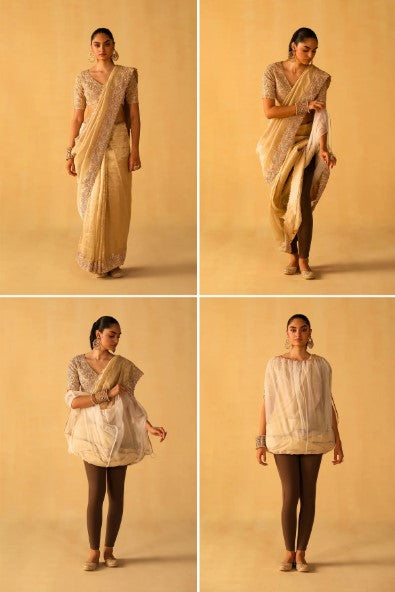
Among all garments in the world, the saree stands apart for a remarkable reason: it begins as a simple flat rectangle of fabric and transforms into a sophisticated three-dimensional form without cutting, stitching, or permanent shaping.
This transformation is not merely artistic—it reflects principles found in an advanced branch of mathematics known as Topology. While most people associate the saree with culture, tradition, and fashion, it can also be understood as a living example of topological transformation, where a surface changes its form while preserving its continuity.
The saree is not just worn; it is transformed.
What Is Topology?
Topology is often described as the mathematics of shape and transformation.
Unlike traditional geometry, which focuses on measurements and angles, topology studies how objects can be stretched, folded, twisted, and reshaped without being cut or torn.

For example:
-
A sheet of paper can be folded into various forms.
-
A rubber band can be stretched into different shapes.
-
A piece of cloth can be wrapped around complex surfaces.
As long as the material remains connected and continuous, topology considers it the same object.
The saree perfectly demonstrates this principle.
The Saree Begins as a Two-Dimensional Surface
Before draping, a saree is simply:
-
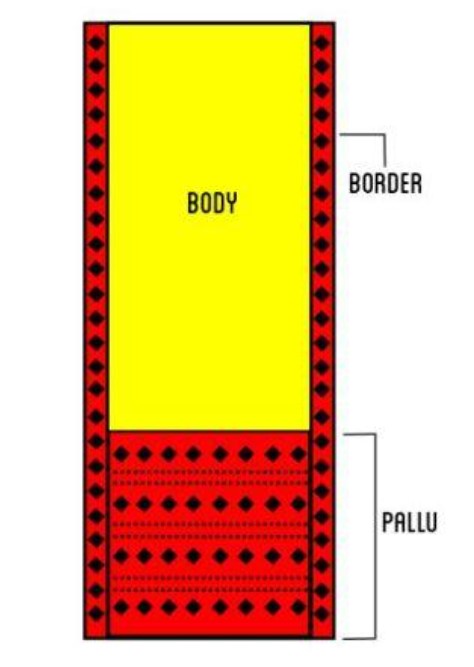
A rectangular piece of fabric
-
Approximately 5.5 to 9 meters long
-
Flexible and continuous
-
Without seams or fixed structure
Mathematically, it exists as a flat two-dimensional surface.
Yet once draped, it acquires:
-
Volume
-
Curves
-
Layers
-
Folds
-
Movement
Without changing the fabric itself.
This is the essence of topological transformation.
From Plane to Human Form
The human body is a highly complex three-dimensional structure composed of:
-
Cylindrical forms (waist, arms)
-
Spherical forms (shoulders)
-
Curved surfaces (torso)
-
Dynamic joints (knees, elbows)
The saree adapts to all these shapes through wrapping and folding.
Rather than forcing the body to fit the garment, the garment transforms itself to fit the body.
This adaptability is one of the saree's greatest engineering achievements.
Folding Without Cutting

Most garments are created by:
-
Cutting fabric
-
Joining panels
-
Stitching seams
-
Creating permanent shapes
A saree follows a completely different philosophy.
It creates shape through:
-
Folding
-
Wrapping
-
Layering
-
Tucking
-
Draping
The original fabric remains intact.
Topology recognizes this as a continuous transformation of a surface.
Pleats: Controlled Topological Compression
One of the most fascinating aspects of saree draping is pleat formation.
Pleats transform a wide surface into a compact structure.
During pleating:
-
Large fabric areas are compressed.
-
Material is folded repeatedly.
-
Surface area remains unchanged.
-
Shape changes dramatically.
This allows meters of fabric to be organized efficiently around the body while preserving mobility and elegance.
Waist Wrapping and Surface Continuity
When wrapped around the waist, the saree forms a continuous surface around a cylindrical structure.
The fabric:
-
Curves around the body
-
Maintains uninterrupted continuity
-
Creates a stable support system
No part of the saree is detached from the whole.
The fabric remains one connected surface throughout the draping process.
This continuity is a fundamental topological characteristic.
The Pallu: A Dynamic Extension
The pallu represents another stage of transformation.
Unlike the structured waist and pleat sections, the pallu remains relatively free.
It introduces:
-
Flow
-
Movement
-
Asymmetry
-
Visual rhythm
As the wearer walks, the pallu continuously changes shape while remaining connected to the main drape.
This creates a living, moving example of topological flexibility.
Infinite Possibilities from One Surface
One saree can be draped in hundreds of ways.
Examples include:
-
Nivi Style
-
Gujarati Style
-
Bengali Style
-
Maharashtrian Style
-
Coorgi Style
-
Madisar Style
Remarkably, all these styles originate from the same rectangular surface.
The fabric remains unchanged; only the arrangement changes.
This demonstrates how topology values transformation over rigid structure.

Why the Saree Is a Designer's Dream
The saree offers something few garments can:
Adaptability
It accommodates different body types naturally.
Scalability
The same fabric can create multiple silhouettes.
Reversibility
It can be completely unfolded and restored to its original state.
Continuity
No permanent alteration is required.
These characteristics align closely with topological principles of flexibility and preservation.
Saree as Living Mathematics
When viewed scientifically, a saree is more than a traditional garment.
It is:
-
A geometric rectangle
-
A flexible surface
-
A topological object
-
A dynamic design system
Each fold, pleat, tuck, and wrap transforms the fabric from a flat plane into a wearable three-dimensional sculpture.
The saree demonstrates that beauty can emerge not from cutting and shaping, but from intelligent transformation.
Tags:
Previous
Chapter 27-Balance & Centre of Gravity in Saree Draping l RESSA
Next
Chapter 29 – One Cloth, Endless Creations l RESSA
Related articles

Jul 29 2026
A Saree as a Guru – Life Lesson
Jul 25 2026
Chapter 25 – The Science of Comfort l RESSA
Jul 25 2026
