


PART 6 — THE MATHEMATICS OF SAREESaree as a Geometric Rectangle: How a Simple Piece of Fabric Creates Infinite Styles
Introduction
At first glance, a saree appears to be one of the simplest garments in the world—a long, unstitched piece of fabric measuring approximately 5.5 to 9 meters in length and 1.1 to 1.2 meters in width. From a geometric perspective, a saree is essentially a rectangle.
Yet, this simple rectangular fabric has the remarkable ability to transform into hundreds of draping styles, adapting to different body types, cultures, occasions, and climates. The saree proves that extraordinary design can emerge from the simplest geometric form.
The Geometry of a Saree
A saree's basic dimensions form a perfect rectangle:
-
Length: 5.5–9 meters
-
Width: Approximately 1.15 meters
-
Shape: Rectangle
-
Structure: Unstitched fabric
Unlike most modern garments that require cutting, stitching, and shaping, the saree retains its original rectangular geometry throughout its use.
A=l×wA = l \times wA=l×w
The saree's area depends entirely on its length and width, creating enough fabric surface to wrap, pleat, and drape around the human body.
Why the Rectangle is a Brilliant Design
1. Zero Fabric Waste
Most garments are created by cutting patterns from fabric, often generating leftover scraps. A saree, however, utilizes the entire rectangular piece without cutting.
Benefits include:
-
Maximum fabric utilization
-
Minimal waste
-
Sustainable design
-
Easy recycling and repurposing
This makes the saree one of the oldest examples of sustainable fashion.
2. Infinite Draping Possibilities
A rectangle may seem limited, but mathematically it offers countless folding and wrapping combinations.
The saree can be:
-
Pleated
-
Folded
-
Wrapped
-
Layered
-
Twisted
-
Draped asymmetrically
This flexibility has given rise to more than 100 documented draping styles across India.
Some famous examples include:
-
Nivi Saree Drape
-
Bengali Saree Drape
-
Gujarati Seedha Pallu
-
Maharashtrian Nauvari
All emerge from the same geometric rectangle.

The Science of Pleats
Pleats are essentially a geometric transformation.
When multiple folds are created:
-
Fabric width is compressed.
-
Thickness increases.
-
Volume is redistributed.
-
Movement becomes controlled

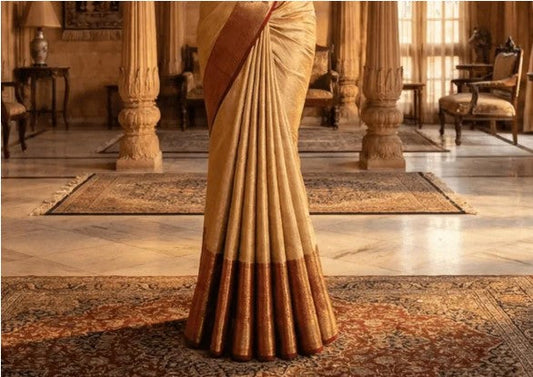
A typical saree may contain:
-
5–10 front pleats
-
Each pleat approximately 4–6 inches wide
These folds convert a flat rectangle into a three-dimensional form that fits the human body comfortably.
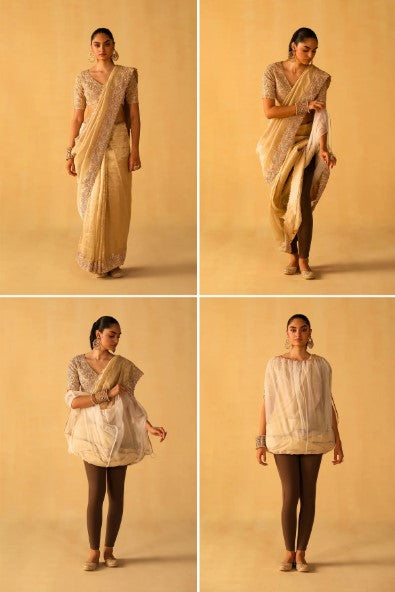
From 2D Fabric to 3D Fashion
One of the most fascinating aspects of a saree is its transformation from a two-dimensional object into a three-dimensional garment.
The process involves:

Step 1: Wrapping
The rectangle begins to curve around the waist.
Step 2: Pleating
Flat surfaces become layered structures.
Step 3: Draping
The pallu creates flowing lines and movement.
Step 4: Body Adaptation
The fabric naturally adjusts to individual body proportions.
In geometry, this is a beautiful example of converting a flat plane into a complex three-dimensional structure.
How Length Changes Function
5.5-Meter Saree
-
Standard modern drape
-
Lightweight and convenient
-
Suitable for everyday wear
6–7 Meter Saree
-
Larger pleats
-
Richer pallu draping
-
Greater styling flexibility
9-Meter Saree
-
Traditional Nauvari and Madisar styles
-
Allows trouser-like lower draping
-
Enhanced mobility
The longer the rectangle, the more geometric possibilities it offers.
The Mathematical Beauty of Symmetry
Many saree designs rely heavily on symmetry.
Examples include:
-
Balanced borders on both sides
-
Repeating motifs
-
Mirror-image embroidery
-
Equal pleat spacing

Human beings naturally find symmetrical patterns attractive, which is one reason sarees appear visually harmonious and elegant.
Geometry in Saree Design
Designers often use geometric principles such as:
Borders
Straight parallel lines running along the length.
Checks
Square and rectangular grids.
Stripes
Repeated linear patterns.
Motifs
Circles, diamonds, triangles, and polygons.
Pallu Design
A focal area often based on symmetrical geometric arrangements.
Traditional Indian textile artisans have been applying geometric concepts for centuries, long before modern design software existed.
-
Draping: The Fascinating 3D Transformation of a 2D Fabric
Introduction
A saree begins its journey as a simple, flat piece of fabric. Spread on a surface, it exists only in two dimensions—length and width. Yet, within minutes, this same fabric transforms into an elegant garment that wraps, flows, and adapts to the human body.
This remarkable process is known as draping—the art and science of converting a 2D fabric into a 3D form.
The saree is perhaps one of the finest examples of this transformation, showcasing how a flat textile can become a dynamic structure without a single cut or stitch.
Understanding 2D and 3D Forms

A fabric lying flat possesses:
-
Length
-
Width
-
Surface area
It has very little structural volume.
A human body, however, is a three-dimensional form with:
-
Height
-
Width
-
Depth
-
Curves and contours
The challenge of draping is to make a flat surface conform naturally to a complex 3D shape.
The Science Behind Draping
When a saree is draped, several geometric transformations occur simultaneously:
Wrapping
The fabric moves from a flat plane into a curved surface around the waist and body.
This transformation converts straight fabric lines into circular and cylindrical forms.
Folding
Pleats are created by repeatedly folding fabric.
These folds:
-
Reduce width
-
Increase thickness
-
Add structure
-
Control movement
The saree changes from a broad rectangle into a compact, wearable form.
Layering
Different sections overlap one another.
Layering creates:
-
Visual depth
-
Better weight distribution
-
Enhanced drape quality
-
Richness in appearance
Hanging
Gravity becomes an important design element.
The pallu hangs naturally, creating:
-
Vertical flow
-
Soft curves
-
Dynamic movement
Unlike stitched garments, the saree continuously responds to gravity and body motion.
From Geometry to Fashion
The saree demonstrates a beautiful geometric transformation.

Stage 1: Flat Rectangle
The saree begins as:
A=l×wA = l \times wA=l×w
A simple rectangular surface
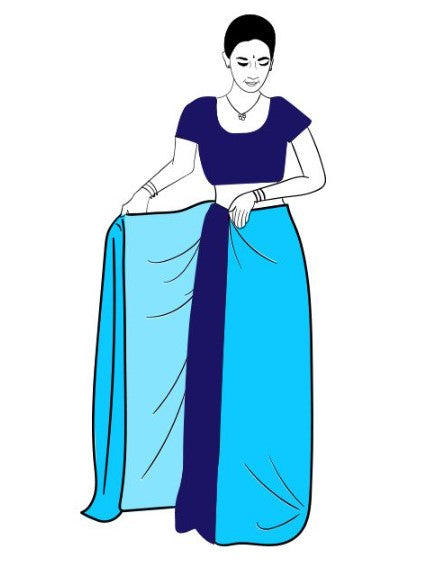
Stage 2: Cylindrical Wrap
The lower section wraps around the waist, creating a cylindrical structure.
This allows the fabric to surround the body while maintaining flexibility.
Stage 3: Pleated Structure
Multiple folds transform excess fabric into organized volume.
Pleats act like movable architectural elements that expand and contract during movement.
Stage 4: Flowing Pallu
The remaining fabric creates a free-flowing extension.
The pallu introduces movement, balance, and visual elegance.
The result is a complete three-dimensional garment.
How the Human Body Shapes the Saree

Unlike pre-stitched clothing, a saree does not force the body into a fixed shape.
Instead, the fabric adapts to:
-
Body size
-
Height
-
Posture
-
Movement
-
Personal draping style
This makes every draped saree unique.
Two women wearing the same saree can create entirely different silhouettes.
The Role of Gravity
Gravity is an invisible designer in every saree drape.
It helps:
-
Pleats fall neatly
-
Pallu flow gracefully
-
Fabric settle naturally
-
Weight distribute evenly
Without gravity, the saree would lose much of its iconic elegance.
Saree Draping and Architectural Principles
Fashion designers often compare draping to architecture.
Both involve:
-
Structure
-
Balance
-
Proportion
-
Flow
-
Stability
Just as architects transform flat drawings into buildings, saree draping transforms flat fabric into wearable art.
Movement Creates a Living Structure
One unique aspect of a saree is that its 3D form is never completely fixed.
As the wearer:
-
Walks
-
Turns
-
Climbs stairs
-
Sits
-
Dances
the drape continuously adjusts itself.
The saree becomes a living structure that responds to motion.
This dynamic quality distinguishes it from most stitched garments.

Why This Transformation Is Extraordinary
Most modern garments require:
-
Cutting
-
Stitching
-
Tailoring
-
Pattern-making
The saree requires none of these.
A single uncut piece of fabric transforms into a sophisticated garment purely through:
-
Folding
-
Wrapping
-
Tucking
-
Draping
It is one of the world's oldest examples of wearable engineering.
The Role of Folding Geometry in Saree Pleat Formation
Introduction
One of the most recognizable features of a saree is its pleats. Those neatly arranged folds at the waist may appear simple, but they are actually a fascinating example of folding geometry in action.
Pleats transform a large, flat piece of fabric into a structured, elegant, and wearable form. Without pleats, a saree would be difficult to manage, uncomfortable to walk in, and far less graceful in appearance. The science behind pleat formation combines geometry, symmetry, engineering, and aesthetics.
What Is a Pleat?
A pleat is a series of folds created by repeatedly folding fabric back and forth.
Think of a paper fan:
-
A flat sheet is folded into equal sections.
-
The folds reduce width.
-
Thickness increases.
-
The structure becomes compact and flexible.
A saree pleat works on the same principle.

Folding Geometry: Converting Width into Depth
The primary function of pleating is to convert excess fabric width into organized layers.
For example:
-
A section of saree fabric may be 1 meter wide.
-
Through folding, that width is compressed into a small bundle of pleats.
-
The lost width does not disappear—it becomes depth and volume.
This is a geometric transformation where:
Surface area remains the same, but the shape changes dramatically.
The Accordion Fold Principle
Most saree pleats are based on the accordion fold pattern

4In this pattern:
-
One fold goes forward.
-
The next fold goes backwar
-
This sequence repeats.
Benefits include:
-
Compact arrangement
-
Equal distribution of fabric
-
Easy expansion during movement
-
Better balance
This is the same folding principle used in paper fans, architectural structures, and expandable materials.
Symmetry Creates Beauty
Well-made saree pleats are usually symmetrical.
Characteristics include:
-
Equal width folds
-
Parallel edges
-
Consistent spacing
-
Uniform alignment
Human eyes naturally appreciate symmetry because it creates visual harmony.
Neatly arranged pleats make the saree look elegant, organized, and refined.

Why Pleat Width Matters
The width of each pleat affects the final appearance.
Narrow Pleats
-
More folds
-
Greater fluidity
-
Rich visual texture
-
Softer movement
Wider Pleats
-
Fewer folds
-
Bolder appearance
-
Greater volume
-
Stronger silhouette
Most traditional saree drapes use pleats between 4 and 6 inches wide to achieve a balance between comfort and elegance.
Pleats as Weight Management Systems
A saree can weigh anywhere from a few hundred grams to several kilograms, depending on the fabric and embellishments.
Pleats help by:
-
Distributing weight evenly
-
Reducing strain on a single point
-
Stabilizing the drape
-
Preventing fabric bunching
In engineering terms, pleats act like a load-distribution mechanism.

Movement and Dynamic Expansion
One remarkable feature of pleats is their ability to expand and contract.
When the wearer:
-
Walks
-
Climbs stairs
-
Sits
-
Dances
the pleats open slightly and then return to their original shape.
This flexibility allows freedom of movement while maintaining structure.
The Mathematics of Pleat Formation
Suppose:
-
Total pleated fabric = 60 inches
-
Each pleat uses 5 inches of fabric
Then:
Number of Pleats=605=12\text{Number of Pleats} = \frac{60}{5} = 12Number of Pleats=560=12
The number and size of pleats directly affect the drape's appearance and volume.
This demonstrates how simple mathematical principles influence saree styling.

Pleats and Architectural Design
Architects often use folding geometry to create structures that are:
-
Strong
-
Flexible
-
Efficient
Similarly, saree pleats:
-
Add structure without stitching
-
Increase stability
-
Maintain flexibility
-
Enhance visual appeal
The same principles can be seen in folded roofs, bridges, and modern kinetic architecture.
The Role of Fabric in Pleating
Different fabrics respond differently to folding geometry.
Cotton
-
Holds sharp pleats well
-
Creates defined structure
Silk
-
Produces elegant, soft folds
-
Adds richness and volume
Georgette and Chiffon
-
Creates fluid pleats
-
Allows greater movement
Organza
-
Forms crisp architectural pleats
-
Maintains shape for longer
Thus, fabric properties influence how geometric folds behave.
Why Pleats Define the Saree
Pleats are more than a decorative feature—they are the engineering system that makes the saree functional.
They:
-
Organize excess fabric
-
Create movement
-
Improve comfort
-
Enhance beauty
-
Support body mobility
Without pleats, the saree would remain a flat rectangle. Through folding geometry, it becomes a sophisticated three-dimensional garment.
Symmetry and Asymmetry in Saree Styling: The Secret Behind Its Timeless Elegance
Introduction
The saree is often admired for its beauty, grace, and versatility. However, beyond its rich fabrics and intricate designs lies a fascinating design principle that contributes significantly to its appeal: the balance between symmetry and asymmetry.
From neatly arranged pleats to the flowing pallu draped over one shoulder, a saree beautifully combines order with movement. This interplay of symmetry and asymmetry is what gives the saree its unique visual charm and makes it one of the most elegant garments ever created.
Understanding Symmetry and Asymmetry
In design and geometry, symmetry refers to balance, where elements are arranged evenly and harmoniously. Asymmetry, on the other hand, introduces variation, movement, and visual interest by placing elements unevenly while still maintaining overall balance.
Great design often relies on a combination of both. Too much symmetry can feel rigid and predictable, while too much asymmetry can appear chaotic. The saree achieves a perfect balance between these two principles.

Symmetry: The Foundation of Saree Elegance
Many aspects of a saree are rooted in symmetry.
The Rhythm of Pleats
The front pleats of a saree are typically folded with equal width and spacing. These repeated folds create a sense of order and rhythm, making the drape appear neat and refined.
The human eye naturally appreciates repetition and balance, which is why well-arranged pleats instantly enhance the elegance of the saree.
Balanced Borders and Motifs
Traditional sarees often feature symmetrical elements such as:
-
Parallel borders running along both sides
-
Repeating floral or geometric motifs
-
Uniform embroidery patterns
-
Consistent weaving designs
These features create visual harmony and give the saree a structured appearance.
Visual Stability
Symmetry provides a sense of stability and sophistication. It ensures that the saree looks balanced from different angles and helps create a polished overall silhouette.

Asymmetry: The Element of Grace and Movement
While symmetry provides structure, asymmetry brings life to the saree.
The Pallu Effect
The most recognizable asymmetrical feature of a saree is the pallu. Draped over one shoulder, the pallu immediately breaks perfect symmetry and creates a focal point.
This asymmetrical placement:
-
Adds visual interest
-
Creates flowing movement
-
Highlights craftsmanship and design
-
Draws attention to the upper body
The pallu transforms a simple drape into an expressive fashion statement.
Dynamic Silhouettes
Unlike stitched garments that maintain a fixed shape, sarees change with movement. As the wearer wal

ks, turns, or gestures, the pallu and fabric folds create ever-changing lines and curves.
This dynamic quality is a direct result of asymmetry.
The Perfect Balance Between Order and Freedom
What makes the saree truly remarkable is how it combines these opposing principles.
|
Symmetry |
Asymmetry |
|
Pleats |
Pallu |
|
Borders |
Shoulder Drape |
|
Repeating Motifs |
Flowing Fabric |
Symmetry provides the framework, while asymmetry adds personality and expression.
Together, they create a garment that feels both organized and graceful.
Regional Draping Styles and Visual Balance

Different regions of India interpret symmetry and asymmetry in unique ways.
Gujarati Drape
The pallu is brought to the front, creating a distinct asymmetrical appearance while maintaining balanced pleats.
Bengali Drape
A wider, more dramatic pallu creates bold movement and visual contrast.
Nauvari Saree
The nine-yard drape distributes fabric differently around the body, creating a unique balance of structure and freedom.
Each style demonstrates how the same rectangular fabric can achieve different visual effects through varying uses of symmetry and asymmetry.
Why the Human Eye Loves Sarees
Psychologists and designers often note that humans are naturally attracted to balanced compositions that include a touch of variation.
A saree satisfies both instincts:
-
Symmetry provides comfort and harmony.
-
Asymmetry creates excitement and individuality.
This combination keeps the saree visually engaging without overwhelming the viewer.

Lessons for Modern Fashion
Many contemporary designers apply the same principle in modern saree styling:
-
Structured pleats paired with flowing pallus
-
Symmetrical embroidery contrasted with asymmetrical draping
-
Geometric patterns balanced with soft fabric movement
These techniques demonstrate that the design philosophy behind the saree remains relevant even in contemporary fashion.
Tags:
Previous
Chapter 26- The Science of Pleats and Support l RESSA
Next
Chapter 28 – The Hidden Architecture of a Saree l RESSA
Related articles

Jul 29 2026
A Saree as a Guru – Life Lesson
Jul 25 2026
Chapter 25 – The Science of Comfort l RESSA
Jul 25 2026
